 November 3, 2026
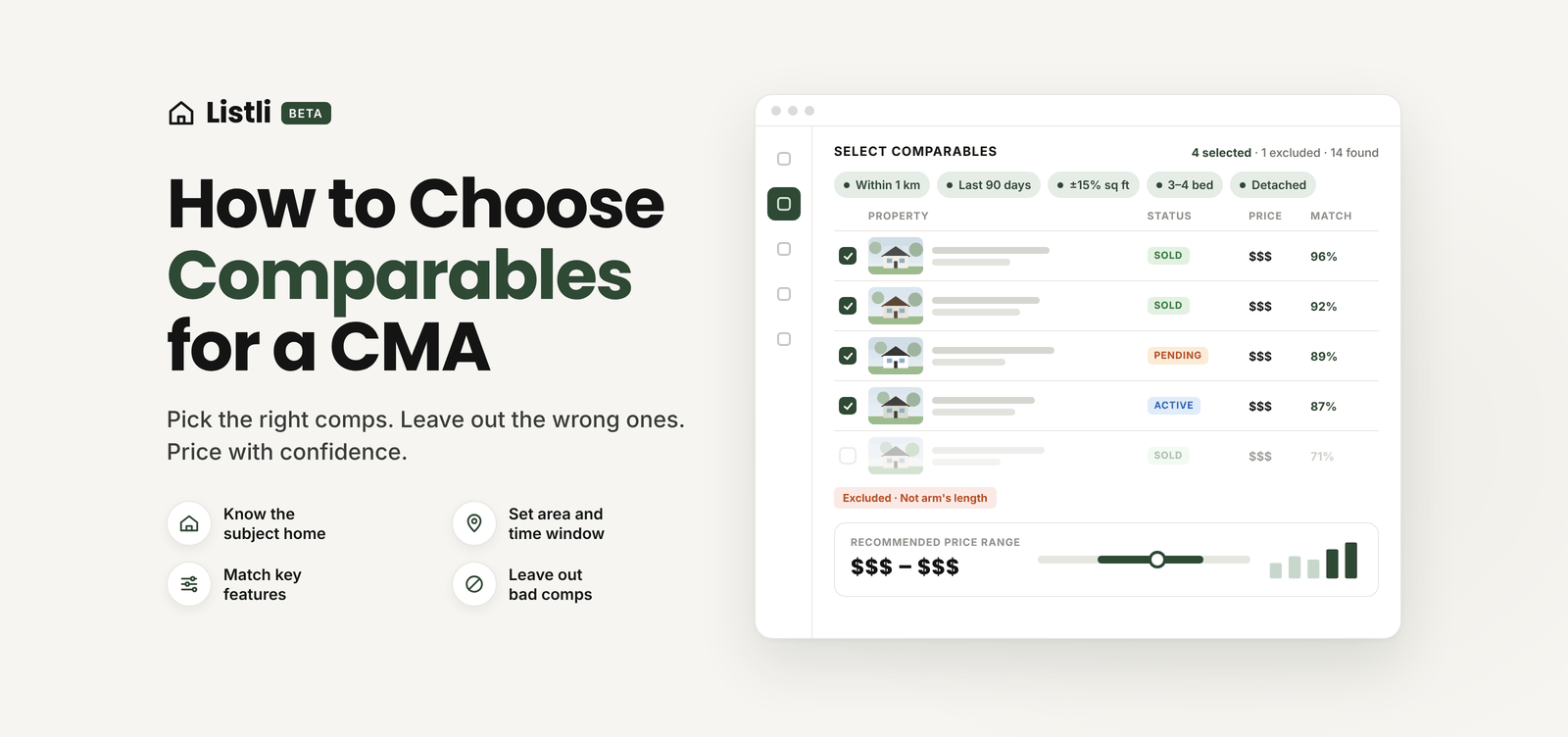
How to Choose Comparables for a CMA
How to Choose Comparables for a CMA (and Which to Leave Out)
Every agent has sat across from a seller who points to the highest sale on the street and says, "So we're worth at least that, right?" Your answer to that question is only as strong as the comps behind it.
After more than 10 years pricing homes on Vancouver Island, I've learned that most weak CMAs don't fail on the math. They fail on comp selection. Pick the wrong comparables and even a perfectly formatted report points to the wrong price. Pick the right ones and the pricing conversation almost runs itself.
Quick answer: To choose comparables for a CMA, start with homes in the same neighbourhood that sold in the last 90 days and match the subject on property type, size (within about 15 percent), bedrooms, bathrooms, age and condition. Add active, pending and expired listings for context. Leave out non-arm's-length, court-ordered and outlier sales.
Here is the process I use, step by step, along with the sales I always leave out.
Step 1: Know the subject property before you search
You can't judge what's comparable until you know exactly what you're comparing against. Before you open a single search, document the subject property in detail.
That means finished square footage, lot size, bedrooms and bathrooms, year built, property type, basement type, parking, view, and every renovation with an approximate year. Walk the home if you can. The listing history and assessment record won't tell you the kitchen was redone last spring or that the backyard backs onto a busy road.
This step sets your filters for everything that follows. If you're fuzzy on the subject, your comps will be too.
Step 2: Set your search area
Location is the one thing a seller can't renovate, so it's where comp selection starts. The best comps sit in the same neighbourhood, ideally within the same subdivision or a few blocks of the subject.
Draw your boundary based on how buyers shop, not just distance. A home on the other side of a major road, in a different school catchment, or in a pocket with a different feel can sell very differently, even if it's 500 metres away. In markets like Victoria, Nanaimo or Calgary, two neighbourhoods that touch on a map can carry noticeably different price points.
If you can't find enough comps nearby, widen the radius gradually and note which comps came from outside the core area. You'll weight those less.
Step 3: Pick the right time window
Recent sales reflect the market your seller is actually listing into. Start with sales from the last 90 days.
In a slower market or a niche property type, you may need to stretch to six months. That's fine, as long as you account for how the market has moved since. A sale from six months ago in a rising market understates value today, and the reverse is true in a cooling one. Check your board's monthly benchmark trends to see which way your area has moved.
Whatever window you use, be consistent and be ready to explain it. Sellers notice when one comp is recent and another is a year old.
Step 4: Match on the features that drive value
Once you have a pool of nearby, recent sales, narrow it to homes buyers would genuinely consider side by side. Not every feature carries equal weight, so prioritise the ones that move price.
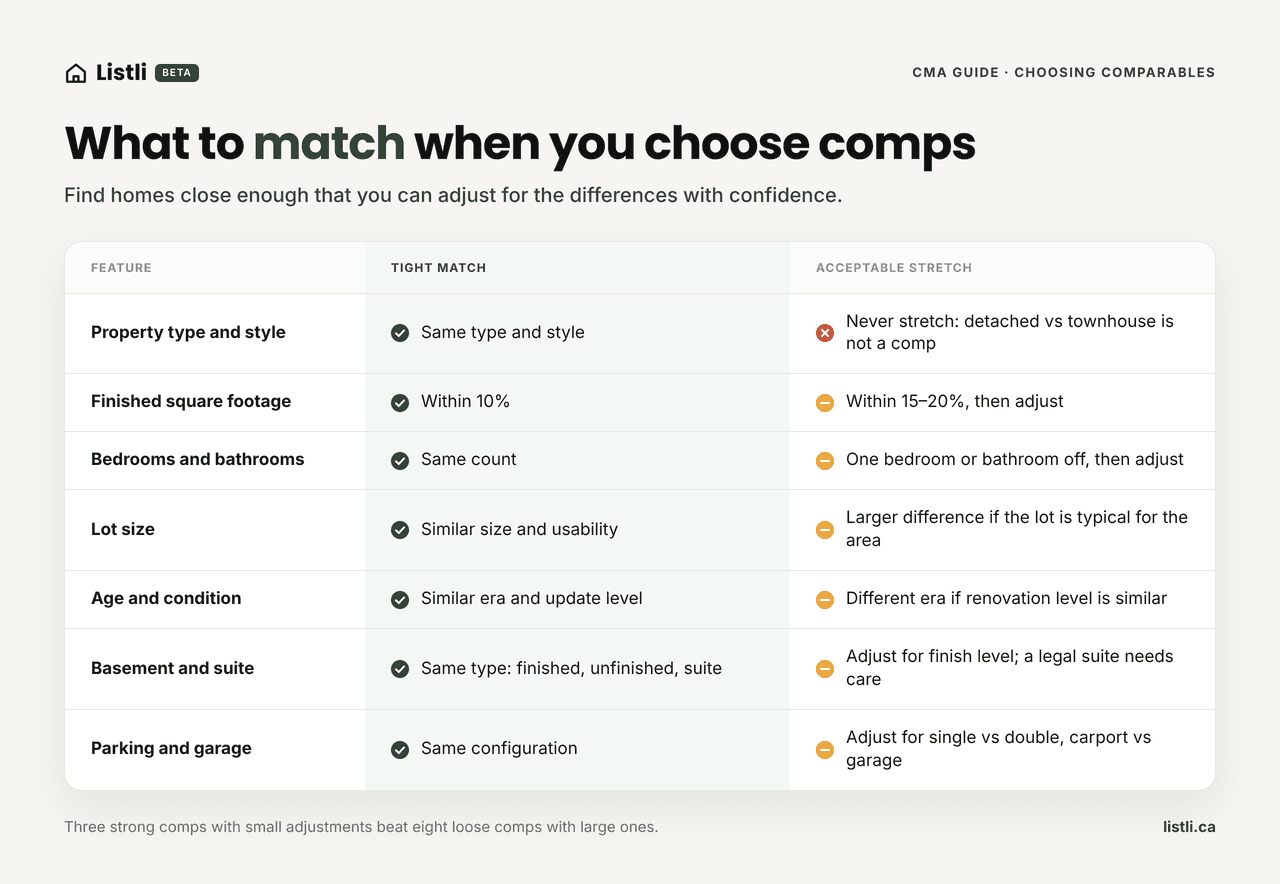
That filtering work is where most of the hours go in a traditional CMA. Listli pulls your comps from MLS® data and lets you narrow them in a few clicks. See what a finished report looks like.
Step 5: Look beyond sold listings
Sold comps tell you what buyers paid. But a seller lists into today's market, so a complete CMA uses all four listing statuses.
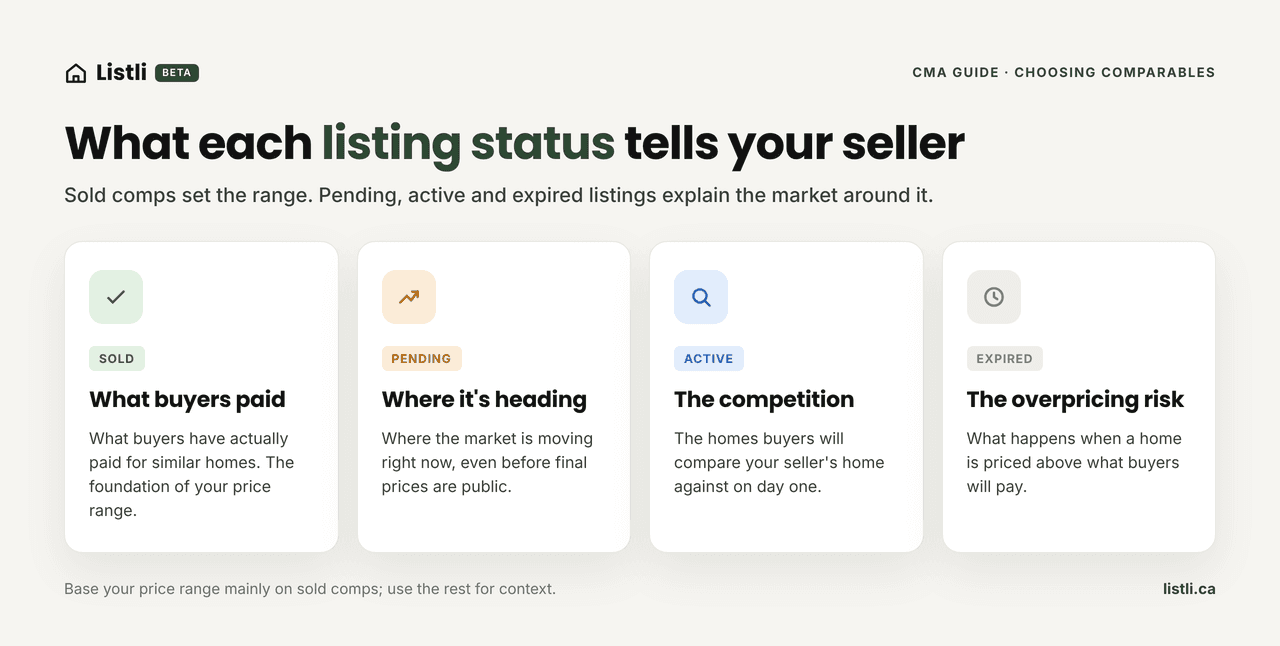
Expired listings are especially useful with a seller who wants to start high. Showing them similar homes that sat and expired at that price makes the conversation about the market, not about your opinion. I cover this more in How to Create a CMA for a Home Step by Step.
Which comparables to leave out
Knowing what to exclude matters as much as knowing what to include. These sales can look like comps on paper but will distort your range:
Non-arm's-length sales: transfers between family members, business partners or related parties rarely reflect open-market value.
Court-ordered and distressed sales: court-ordered sales, estate sales sold as-is, and properties marketed for a quick sale often close below market.
Sales with bundled extras: a price that included furniture, a vehicle or equipment overstates the home's value.
Different property types: a duplex, a home with a legal suite, or an acreage isn't a fair comp for a standard detached home, and vice versa.
Major condition mismatches: a gutted fixer or a full custom rebuild can't be adjusted fairly against a typical home.
Outliers you can't explain: if one sale sits far above or below the rest and you can't find out why, leave it out or flag it.
Pre-sale assignments: they price future delivery, not today's market (more on this in How to Do a CMA for a Condo).
When you do exclude a sale the seller is likely to know about, say so. "I looked at 123 Main Street, and here's why I left it out" builds far more trust than hoping they don't ask.
How many comps do you need?
For most residential CMAs, aim for three to six sold comparables, plus two to four active listings and any relevant pendings or expireds.
Fewer than three sold comps makes your range hard to defend. More than eight usually means some of them are weak, and weak comps dilute strong ones. If you only have two close matches, it's better to present two strong comps with a clear explanation than to pad the report with properties that don't belong.
Frequently asked questions
How far back should comparables go in a CMA? Start with the last 90 days. In slower markets or for unusual properties, you can go back six months, but adjust for any market movement since the sale date.
How close should comps be to the subject property? As close as possible, ideally the same neighbourhood or subdivision. Draw the boundary around how buyers shop, so avoid crossing major roads, school catchments or distinct pockets unless you have to.
Can I use active listings as comparables? Yes, as context. Active listings show the competition, but they're asking prices, not proof of value. Base your price range mainly on sold comps.
What if there are no good comparables? Widen your search area and time window step by step, weight the closest matches most heavily, and explain your reasoning to the seller. Be transparent that the data is thin.
Final thoughts
Comp selection is where your judgment as a REALTOR® shows up most clearly in a CMA. Anyone can pull a list of nearby sales. Choosing the right ones, leaving out the wrong ones, and explaining both is what makes a seller trust your number.
Get the comps right and the rest of your CMA gets easier: your adjustments are smaller, your range is tighter, and your pricing conversation is calmer. If you're new to the process, start with What Is a CMA in Real Estate?
That's exactly why I built Listli. It pulls comparables from real MLS® data, gives you practical filters to narrow them fast, and turns your selections into a clean, branded report your clients can follow. You spend less time searching and formatting, and more time advising.
Start your 14-day free trial, no credit card required. Listli is live on Vancouver Island, in Calgary, in the Okanagan region, and in Colorado. See if your market is covered.