 May 12, 2026
How to Create a CMA for a Home Step by Step
As a real estate agent, one of the most important skills you can develop is knowing how to create a strong Comparative Market Analysis. A CMA helps you estimate a home’s fair market value by comparing it to similar properties in the same area.
But doing a CMA for a house is not just about pulling a few sold listings and averaging the prices. A good CMA helps you explain the market clearly, support your pricing recommendation, and build trust with your client.
Whether you are preparing for a listing appointment or helping a buyer understand value, here is a step-by-step process for creating a real estate CMA that is accurate, professional, and easy to present.
Step 1: Start with the subject property
Before you compare the home to anything else, you need to understand the subject property clearly.
Start by reviewing the property address, square footage, lot size, number of bedrooms and bathrooms, property type, age, condition, layout, renovations, parking, basement features, and any unique selling points.
This step matters because every adjustment you make later depends on how well you understand the home itself. A renovated home with a finished basement, updated kitchen, and strong curb appeal should not be compared the same way as a similar-sized home that needs major work.
The more accurate your starting point is, the stronger your CMA report will be.
Step 2: Search for comparable properties
The next step in doing a CMA for a house is finding comparable properties, often called “comps.”
The best comps are homes that are similar to the subject property in location, size, style, condition, and features. Ideally, they should be in the same neighbourhood or very close nearby. They should also be recent enough to reflect the current market.
When possible, look for homes that match the subject property on:
Property type
Number of bedrooms and bathrooms
Approximate square footage
Lot size
Age and style of home
Condition and upgrades
Garage or parking
Basement type
Location and neighbourhood appeal
The goal is not to include every property that sold nearby. The goal is to select the properties that help tell the most accurate pricing story.
Step 3: Review sold listings first
Sold listings are usually the foundation of a comparative market analysis because they show what buyers have actually paid for similar homes.
When reviewing sold properties, look closely at the sale price, list price, days on market, sale date, and how each home compares to the subject property.
A home that sold six months ago may not be as relevant in a fast-moving market. A home that sold across a major road, in a different school zone, or with a very different lot may need to be weighted differently.
Sold listings help establish the market range, but they should still be interpreted carefully. Not every sale deserves equal weight.
Step 4: Look at active and pending listings
A strong CMA should also consider active and pending listings.
Active listings show your client what they are competing against right now. If similar homes are currently listed lower, that can affect how buyers perceive the subject property. If active listings are priced higher but sitting on the market, that can also tell an important story.
Pending listings, where available, can help show where the market may be heading. They may not always reveal the final sale price right away, but they can still provide useful context around buyer demand and pricing momentum.
This is especially important when presenting a CMA to a seller. They need to understand not only what homes have sold for, but also what buyers are seeing today.
Step 5: Consider expired or stale listings
Expired, cancelled, or long-standing listings can be very useful in a real estate CMA.
These properties help explain what happens when a home is overpriced, poorly positioned, or not aligned with buyer expectations. They are especially helpful when a seller has an unrealistic price in mind.
Instead of simply telling a client their price is too high, you can show them examples of similar homes that failed to sell at certain price points. This makes the conversation more objective and easier to understand.
A great CMA does not just support the recommended price. It also helps explain the risk of pricing incorrectly.
Step 6: Adjust for key differences
Once you have selected your comps, compare them against the subject property and account for major differences.
This includes upgrades, condition, lot size, finished basements, views, layout, parking, location, and overall presentation. Two homes may look similar on paper but feel very different in person.
This is where your experience as a real estate agent becomes valuable. A CMA is not only data entry. It requires judgment.
For example, a slightly smaller home with high-end renovations may be more relevant than a larger home that needs updates. A home on a quiet street may perform differently than a similar home on a busy road.
Your pricing recommendation should reflect these real-world differences.
Step 7: Establish a realistic price range
After reviewing the data, your goal is to determine a realistic price range for the house.
A CMA should usually show a range rather than only one number. This gives the client a better understanding of where the property sits in the market and allows room for strategy.
For example, you may identify a conservative price, a likely market value, and an aggressive listing price. This helps frame the conversation around both value and positioning.
The right price depends on the seller’s goals, the market conditions, the level of competition, and how quickly they want to sell.
Step 8: Explain the pricing strategy
One of the most important parts of doing a CMA is explaining your reasoning clearly.
Your client should understand why you selected certain comps, why some listings were excluded, how the home compares to the market, and why you are recommending a specific price range.
This is where a CMA becomes more than a report. It becomes a conversation.
A seller does not just want to know what their home may be worth. They want to feel confident that you understand the market and have a clear plan to position their property properly.
Step 9: Create a clean, client-ready CMA report
Presentation matters. Even if your analysis is strong, a cluttered or confusing CMA report can make it harder for your client to follow your recommendation. A clean, organized, branded report helps your client understand the information and see you as prepared and professional.
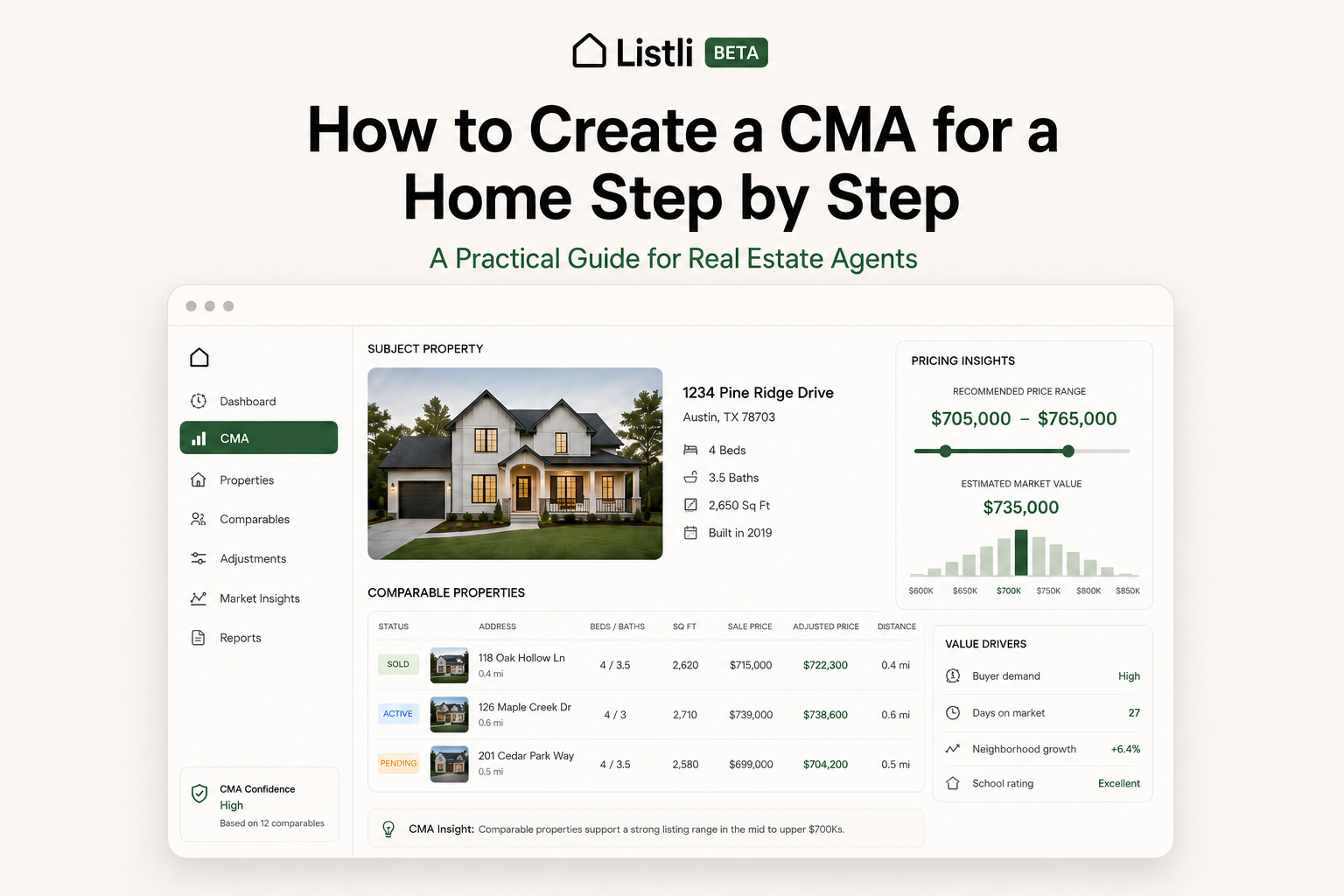
Your CMA report should be easy to read and include the subject property, selected comparables, pricing insights, market context, and your recommended range.
The best CMA reports are not overloaded with unnecessary data. They are clear, visual, and built to support a confident pricing conversation.
Final thoughts
Learning how to do a CMA for a house step by step is one of the most valuable skills a real estate agent can develop.
A strong comparative market analysis helps you price with confidence, educate your clients, and support your recommendations with real market data. But the best CMAs do more than estimate value. They help clients trust your process.
As a real estate agent myself, I built Listli to make this easier. Listli helps REALTORS® create polished, client-ready CMA reports using real MLS® data, comparable property insights, and clean branded presentation tools, so you can spend less time formatting reports and more time winning listings.