 June 2, 2026
How to Do a CMA for a Condo
If you work in a market with a strong condo inventory, you already know this: pricing a strata unit is not the same as pricing a detached home. The process looks similar on the surface, but the variables are different, the pitfalls are more subtle, and the margin for error is thinner.
After more than 10 years working with buyers and sellers across Vancouver Island, I have come to treat condo CMAs as their own discipline. The unit itself is just the starting point. What you are really pricing is a share of a building — and that means the analysis has to go deeper than most agents realize.
Why condo CMAs require a different approach
With a single-family home, you are largely pricing land plus structure. With a condo, you are pricing the unit, its position within the building, the strata corporation's financial health, monthly fees, parking and storage entitlements, and the demand for that specific building, not just the neighbourhood.
Miss any of those layers and your CMA is built on incomplete information, no matter how clean your comparables look. I have seen two side-by-side units in the same building sell $40,000 apart because one had a titled storage locker and a covered parking stall while the other had neither. That kind of detail changes the number significantly.
Start with the subject property, in detail
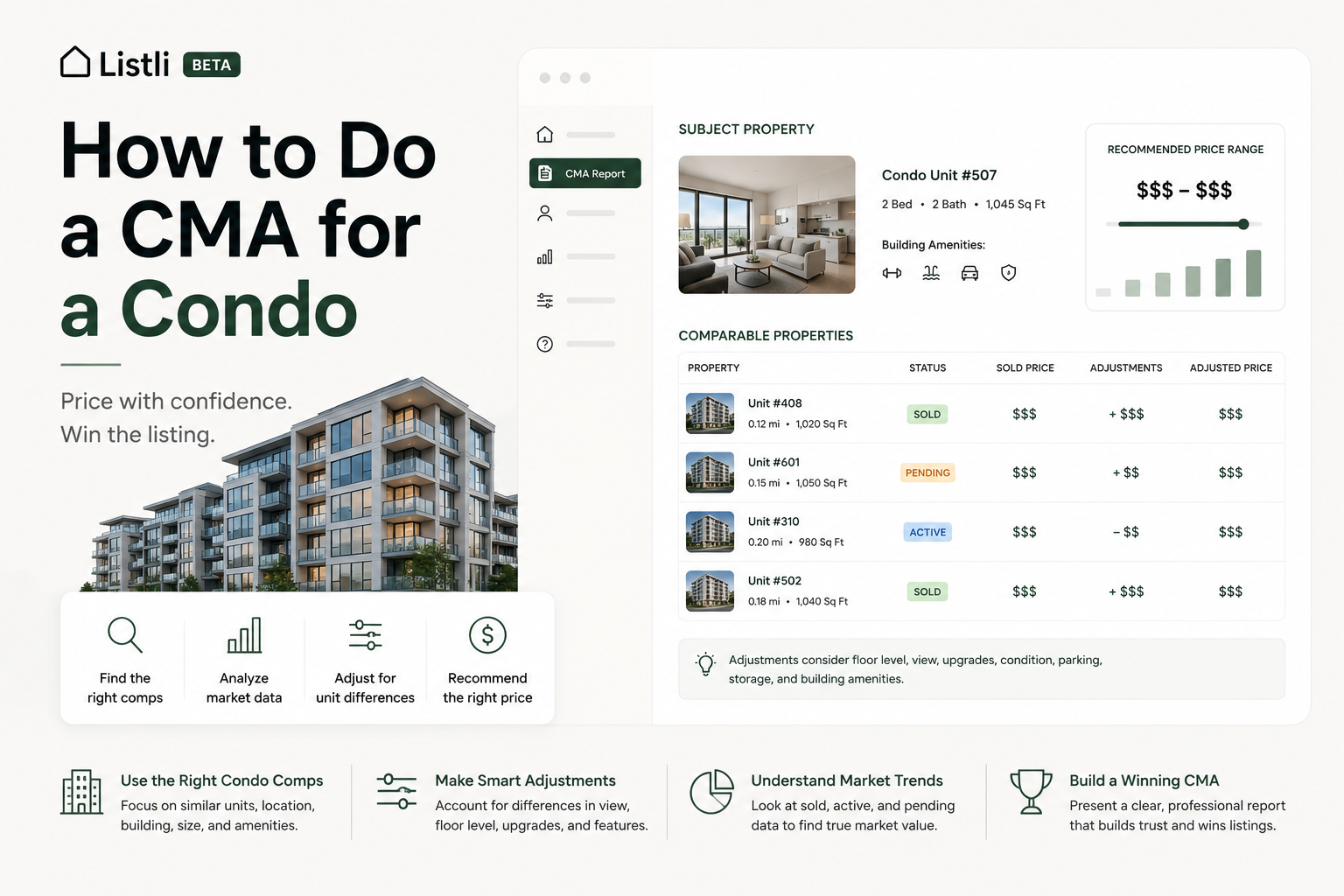
Before pulling a single comparable, document the subject unit precisely. That means the strata lot number, interior square footage as per the strata plan rather than the listing, floor level, unit position, orientation, parking and storage entitlements, balcony size, view, and any renovations completed with approximate years.
This step matters more than most agents give it credit for. Floor level, orientation, and entitlements are not minor adjustments. In markets like Victoria or Nanaimo, a water view versus no view can represent a 10 to 15 percent value swing. A south-facing unit in a well-positioned building commands a meaningful premium over an identical north-facing unit in the same complex. Getting this documentation right before you touch your comps is what separates a precise CMA from a rough estimate.
Pulling and filtering your comparables
The ideal comparable for a condo CMA is a same-building sale within the last 90 days, at a similar floor level, with similar size and entitlements, from an arm's-length transaction. In practice, you will not always find that. Smaller strata corporations and niche buildings mean thinner data sets, and you often have to expand outward.
When you do, tighten your filters. Avoid units that sold with known deficiencies, sales where personal property was bundled into the price, and pre-sale assignments, which price future delivery rather than current market conditions. If you are using sales beyond 90 days, account for the market shift between then and now. Stale data dressed up as current comps is one of the most common ways a condo CMA loses credibility.
Read the strata documents before you finalize anything
This is the step that separates a surface-level condo CMA from a genuinely useful one, and it is where most agents underinvest their time.
At minimum, you want to review the Form B, which tells you the current strata fees, any outstanding levies against the owner, and unresolved bylaw violations. You want to look at the depreciation report to understand the state of major building components and whether the reserve fund is adequately funded. You want to scan two years of meeting minutes for any pending litigation, deferred maintenance discussions, or rental restriction changes.
A building with a healthy reserve fund, a recent depreciation report, and clean minutes is worth more than an identical building with a depleted reserve and an unresolved envelope claim. That difference has to show up in your analysis. If it does not, your CMA is missing some of the most important context your client needs.
Making your adjustments
Once your comparables are selected and your strata documents reviewed, your adjustments need to be evidence-based, not intuitive. Paired sales analysis is the most defensible approach. Use your comps to establish what the market is actually paying for an extra floor, a water view, a covered parking stall, or a full renovation — not what you think those things are worth.
In most Vancouver Island urban markets, a titled covered parking stall tends to add somewhere in the range of $15,000 to $30,000 in value. A full-size titled storage locker often adds $5,000 to $10,000. Higher strata fees relative to comparable buildings affect buyer purchasing power directly and should be reflected in your adjusted values. Renovation adjustments are worth handling carefully — buyers rarely pay dollar for dollar, so a $60,000 kitchen and bath renovation might reasonably support a $35,000 to $45,000 upward adjustment depending on the building tier.
Presenting your findings to clients
A condo CMA is only as useful as your ability to communicate it clearly. Lead with the building narrative. Sellers and buyers both care about the condition of the building, how it is managed, and what is on the horizon financially. Show your adjustments transparently so clients can follow the logic rather than just accept the conclusion. If there are strata concerns, such as an aging envelope, a depleted reserve fund, or a pending special levy, surface them upfront and explain how they have been factored into the range.
Presentation quality matters more than most agents realize. Even accurate data loses its impact when it is laid out in a cluttered or confusing way. Your CMA is also a reflection of how you work. A clean, well-organized report communicates professionalism before you say a single word in your listing presentation.
Final thoughts
A condo CMA done well takes more time than a standard residential analysis. The unit is just the entry point. The building, the strata, and the entitlements are what you are really pricing. Get those right and your CMA becomes a genuine advisory tool rather than a formality before the listing agreement gets signed.
That extra hour — reading the minutes, pulling the Form B, reconciling the strata fees — is exactly the kind of due diligence that builds long-term trust with clients. And in a referral-driven business, that trust is everything.
That commitment to doing the analysis properly is part of what shaped how I think about tools like Listli. It was built to help agents handle the strata-specific variables that make a condo CMA more complex, and to present that analysis in a clean, client-ready format — so you can spend less time wrestling with formatting and more time actually advising your clients.