 November 3, 2026
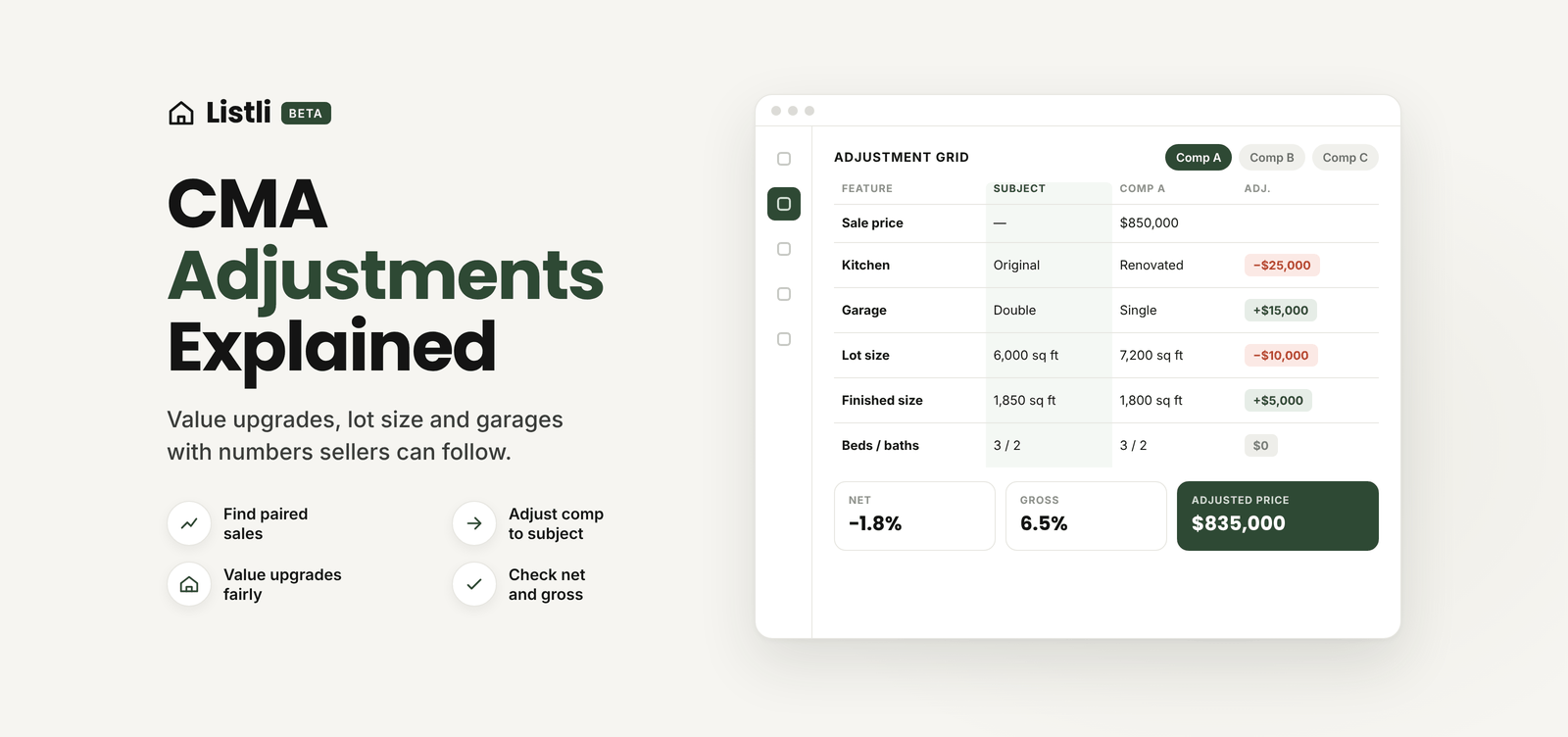
CMA Adjustments Explained: Valuing Upgrades, Lot Size and Garages
CMA Adjustments Explained: Valuing Upgrades, Lot Size and Garages
No two homes are identical. Even the best comparable sale will have a newer kitchen, a bigger lot or one less garage stall than the home you're pricing. Adjustments are how you account for those differences, and they're where a seller decides whether your number makes sense.
In more than 10 years of listing presentations, I've found that sellers rarely argue with the comps themselves. They argue with the gaps. "Their kitchen isn't that much nicer than mine." "Our lot is bigger, shouldn't that count?" Clear, consistent adjustments are what let you answer those questions calmly.
Quick answer: CMA adjustments are dollar amounts you add to or subtract from a comparable sale's price to account for differences from the subject property. If the comp is better, subtract; if it's worse, add. Base each value on paired sales in your market, and keep total adjustments small enough that the comp is still truly comparable.
Here's how to make adjustments that hold up, with a closer look at the three that come up most: upgrades, lot size and garages.
Step 1: Start with paired sales, not cost
The most defensible way to value a feature is to see what buyers in your market have actually paid for it. That's paired sales analysis.
Find two sales that are as similar as possible except for one feature, such as a double garage versus a single. The difference in their sale prices, after accounting for timing, is a market-based estimate of what that feature is worth. Repeat it with a few pairs and you have a range you can stand behind.
What you shouldn't use is cost. A seller who spent $80,000 on a kitchen will want $80,000 back. The market doesn't work that way, and your adjustment shouldn't either.
If you can't find clean pairs for a feature, lean on your recent sales experience and keep the adjustment conservative. Then say so in your presentation.
Step 2: Adjust the comp, not the subject
This is the rule agents most often get backwards. You always adjust the comparable's sale price toward the subject property.
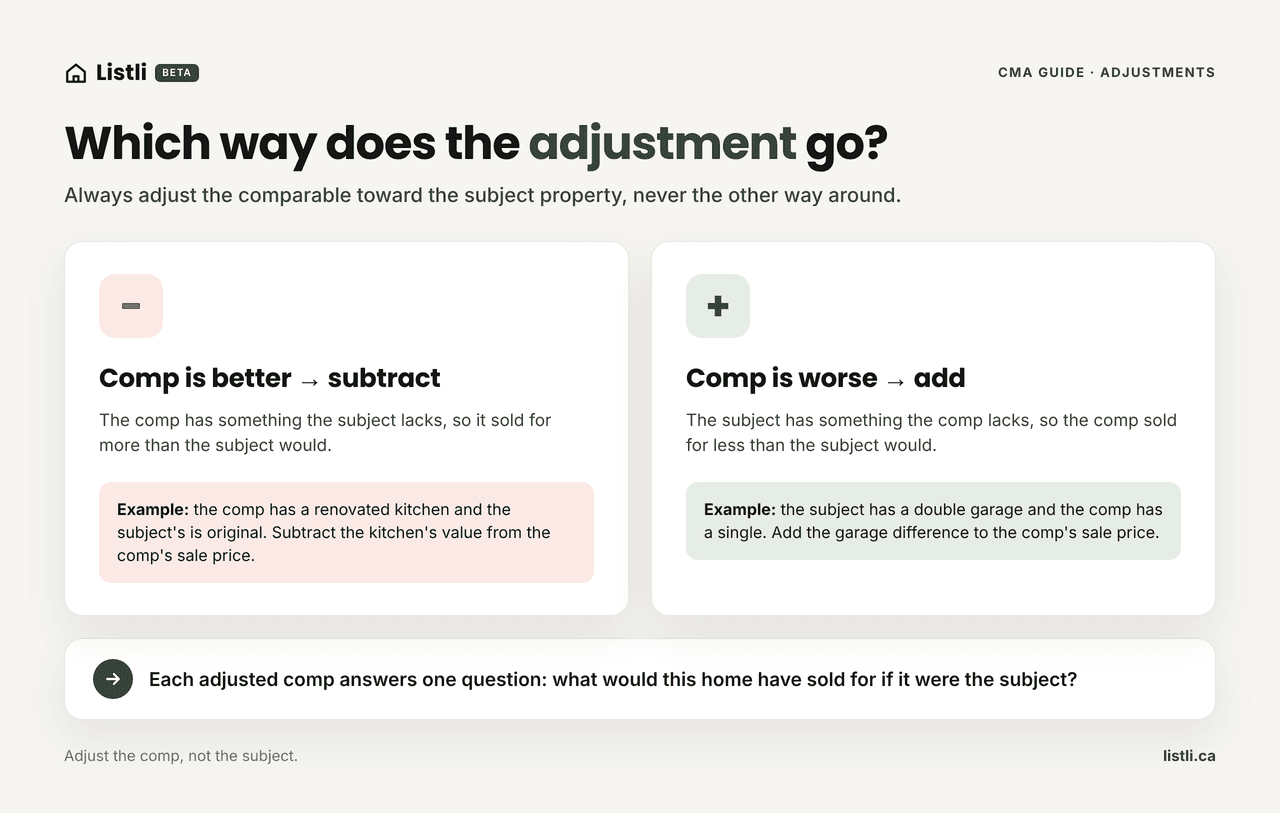
If the comp has a feature the subject lacks, it sold for more than the subject would have, so you subtract. If the subject has something the comp lacks, you add. Every adjusted price then answers the same question: what would this comp have sold for if it were the home you're pricing?
How to value upgrades and renovations
Upgrades are where emotion runs highest, so they need the most care.
Start with this principle: buyers rarely pay dollar for dollar for renovations. As I noted in How to Do a CMA for a Condo, a $60,000 kitchen and bath renovation might support a smaller upward adjustment, depending on the building and price point. The same logic applies to detached homes.
A few things shape how much an upgrade is worth:
Age of the work. A kitchen redone last year carries more value than one redone 12 years ago, even if both were high quality.
Quality relative to the neighbourhood. A luxury kitchen in an entry-level area often adds less than its cost. Buyers in that price band won't stretch far for it.
What buyers expect versus what they reward. A new roof or furnace mostly removes a negative. Buyers expect a sound roof, so it rarely earns a premium the way a renovated kitchen does.
Visible versus hidden. Kitchens, bathrooms and flooring are seen in every showing. Plumbing and electrical upgrades matter, but they show up less in price.
When comps differ in condition, group them by renovation level first (original, partially updated, fully renovated). Then adjust within those groups rather than trying to price every finish.
How to value lot size
Lot size adjustments are easy to overdo. Two homes on the same street can have lots 1,500 square feet apart, and buyers may barely notice.
The key ideas:
Diminishing returns. Extra land adds value, but each additional square foot adds less than the one before, especially once a lot is already typical for the area.
Usable versus total area. A steep, treed or oddly shaped lot can be large on paper and small in practice. On sloped Vancouver Island lots, a flat, usable backyard can matter more than the total size.
Typical lot for the area. If most lots in a Calgary subdivision are similar, a small difference may warrant no adjustment at all. Save larger adjustments for lots that are clearly outside the norm.
Features of the land. Views, privacy, a back lane, or subdivision potential can matter more than square footage. Adjust for those separately.
If you use a per-square-foot rate for land, derive it from paired sales and keep it well below the per-square-foot value of the home itself.
How to value garages and parking
Parking is one of the most reliable adjustments because buyers can compare it easily. But the value depends heavily on the market.
Single versus double. In many suburban markets, a double garage is the expectation for family homes, and a single garage or none at all draws a noticeable discount.
Attached versus detached. In Calgary's established neighbourhoods, a detached double garage off the back lane is common and well valued. In other areas, an attached garage may be what buyers prefer.
Carports and pads. A carport or parking pad has some value, but far less than an enclosed garage. Adjust in steps rather than treating any parking as equal.
Condo parking. For strata units, a titled covered stall is its own adjustment. On Vancouver Island it often adds $15,000 to $30,000, as I covered in the condo guide.
As with upgrades, find the value from pairs in your market rather than applying a fixed number you heard somewhere else.
Putting it together: a worked example
Here's how those adjustments come together for one comp. The figures are illustrative only, but the method is the one I use every time.
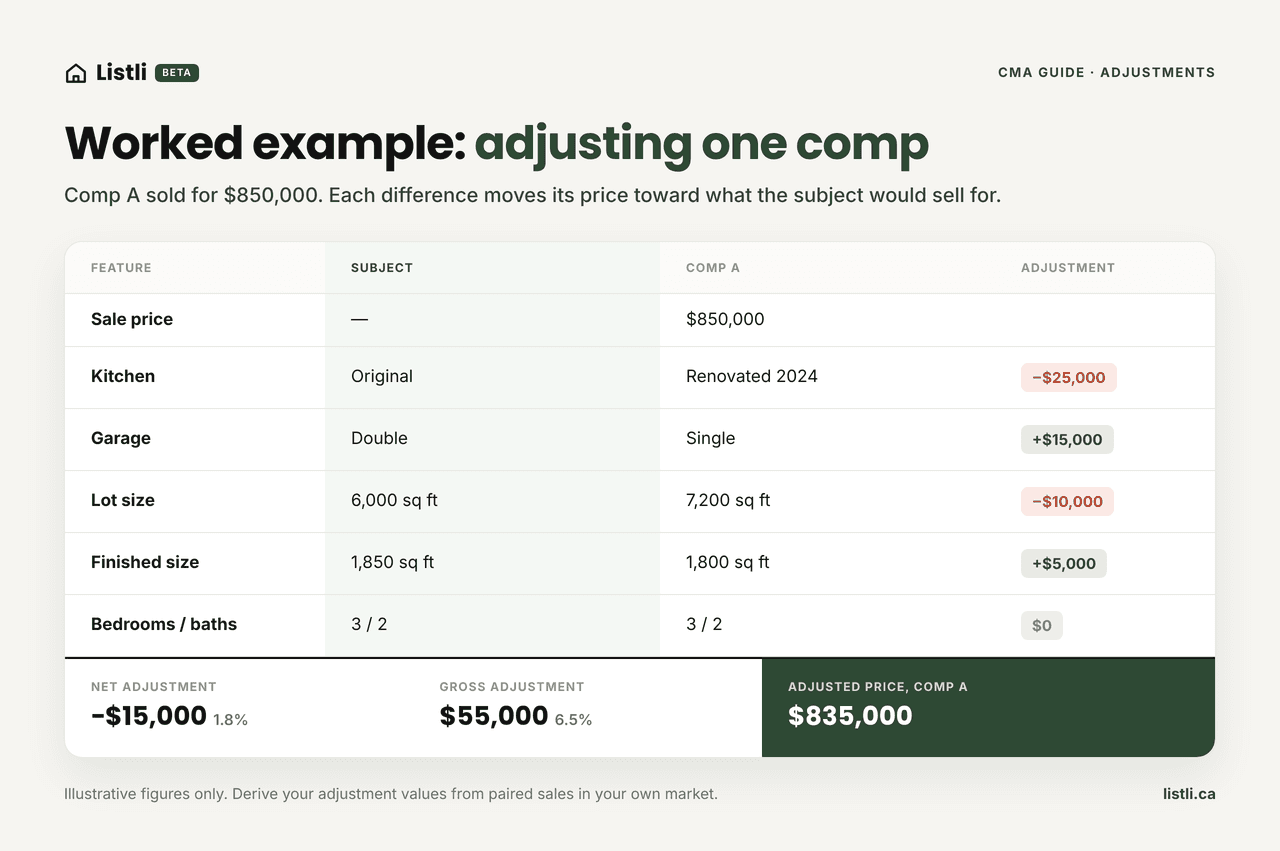
Comp A sold for $850,000. Its renovated kitchen makes it better than the subject, so we subtract. Its single garage makes it worse, so we add. After four adjustments, Comp A indicates a value of $835,000 for the subject. Repeat that for each comp and your adjusted prices form the range you present.
Building this grid by hand in a spreadsheet is where most of the time goes. Listli lays your comps side by side so you can review and adjust them in one place. See what a finished report looks like.
Step 3: Check net and gross adjustments
Before you trust an adjusted comp, check how much you had to change it. Large adjustments are a sign the comp isn't really comparable.
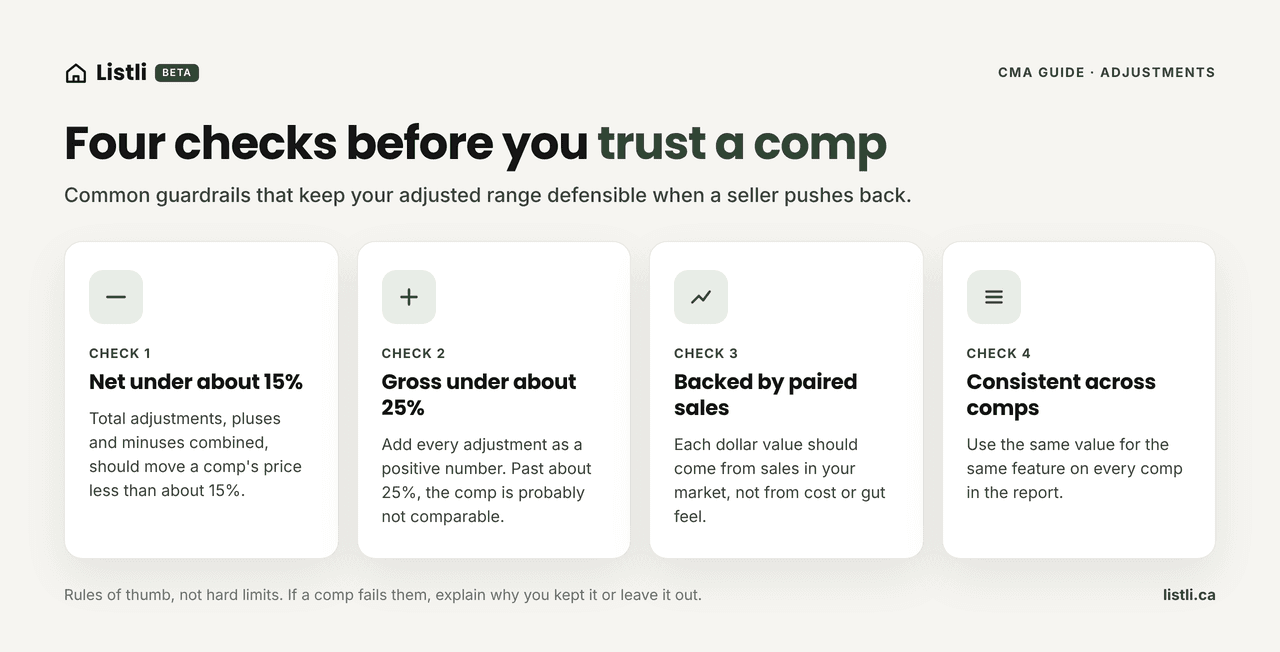
Net adjustment is the total of all pluses and minuses. Gross adjustment is every adjustment added up as a positive number. Many agents and appraisers use about 15% net and 25% gross as rules of thumb. In the example, Comp A's gross adjustment of 6.5% is well within that, so it's a strong comp.
If a comp needs heavy adjustments to fit, you're better off replacing it. I cover how to find stronger matches in How to Choose Comparables for a CMA.
Explaining adjustments to sellers
The best adjustments in the world won't help if your seller can't follow them. A few habits make the conversation easier:
Show the grid. Let the seller see each adjustment and the direction it goes. Transparency builds more trust than a single final number.
Round sensibly. Adjustments in clean increments ($5,000, $10,000) read as professional judgment. Odd figures like $13,742 suggest false precision.
Be consistent. If a garage stall is worth $15,000 on one comp, it's worth $15,000 on every comp in the report.
Lead with the biggest differences. Explain the two or three adjustments that matter most, and summarise the rest.
Frequently asked questions
What are adjustments in a CMA? Adjustments are dollar amounts added to or subtracted from a comparable sale's price to account for differences from the subject property, such as size, condition, lot or parking.
Do you add or subtract when a comp is better than the subject? Subtract. If the comparable has a feature the subject lacks, it sold for more than the subject would, so you lower its price to match.
How do I know how much a feature is worth? Use paired sales: compare two similar sales that differ mainly in that feature. The price difference, adjusted for timing, is a market-based estimate of its value.
How much adjustment is too much? As a rule of thumb, keep net adjustments under about 15% and gross adjustments under about 25% of the comp's sale price. Beyond that, look for a closer comparable.
Final thoughts
Adjustments are where your local knowledge as a REALTOR® turns into numbers. Done well, they show your seller exactly how you got from the comps to their price, and they make overpricing conversations far less personal.
Keep them market-based, keep them consistent, and keep them small enough that every comp still deserves its place. For the full process from start to finish, see How to Create a CMA for a Home Step by Step, or start with What Is a CMA in Real Estate?
That's exactly why I built Listli. It pulls your comparables from real MLS® data, puts them side by side for adjustment, and turns your analysis into a clean, branded report your clients can follow. You spend less time in spreadsheets and more time advising.
Start your 14-day free trial, no credit card required. Listli is live on Vancouver Island, in Calgary and in Colorado. See if your market is covered.